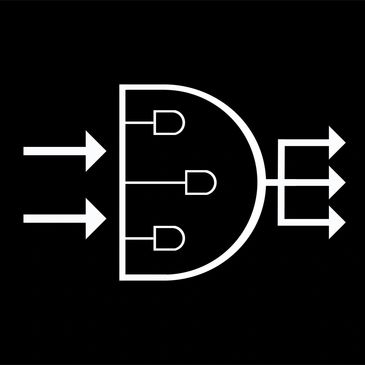
paraDOX™ — the parallel Digital Optical Cross Connect. Built on the principles of packet-switching, and optimized using low density, paraDOX™ isn’t just faster — it’s scalable to thousands of ports. paraDOX™ allows for parallel, modular clusters of logic — distributed and interconnected entirely by light.
paraLITE™ —Parallel Light Integrated Technology, Axonal Network’s optical logic gate merges the interconnection capabilities of light with the computing power of transistors to create a new, more efficient method to calculate and compute data.
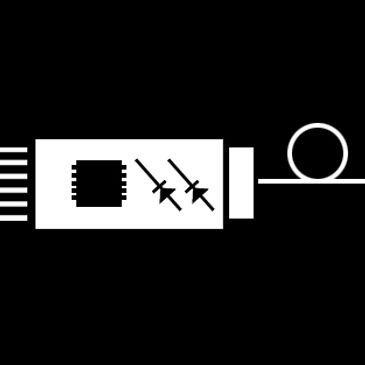
paraNU™ —The next generation of ultra-parallel channel optical transceivers, capable of multi-Terabit aggregate data rates and ultra-low latency.
Chapter 1 / 3
Why Moore’s Law Isn’t Enough.
Chapter 2 / 3
The Energy Cost
Chapter 3 / 3
A Light Speed Future

Our digital world is expanding rapidly. From Artificial Intelligence and the Internet of Things to quantum computing and social media, data flowing across global networks is already immense—and growing exponentially. We are living in the era of data.
Yet the infrastructure that moves this data is reaching its limits. Systems must now move petabits of information every second to keep pace with people, machines, and algorithms. The architectures that have powered networking for decades are straining under this demand, consuming more power while delivering diminishing returns.
As Moore’s Law slows and chip performance gains plateau, the industry faces a fundamental challenge.
What’s needed is a new paradigm—one that evolves the network without disrupting it.
Comparing different types of high-speed switching technologies — and exploring how data travels differently through each.
The opportunity is clear: if we want global, near-instant access to ever-growing amounts of information—especially for AI-driven systems—we must dramatically improve network efficiency.
Today, many systems are starved for data simply because they cannot retrieve it fast enough. CPUs and accelerators often sit idle while waiting for information to arrive. This wastes power, compute cycles, and leaves vast amounts of data effectively inaccessible.
Ensuring that data can move freely and efficiently across the internet is therefore critical—not just for individuals, but for industries, science, economic growth, and global participation.

Nature has long inspired technological breakthroughs—from Velcro to penicillin. Even the foundations of artificial intelligence draw from biology: neural networks were originally inspired by simplified models of the brain.
Axonal Networks builds on this idea, but shifts the focus. Rather than modeling computation around the neuron itself, we look to the brain’s interconnects—axons, dendrites, and synapses—as a blueprint for communication.
The human brain contains trillions of connections, yet it uses them efficiently, distributing resources intelligently while minimizing energy consumption. Nature has evolved a powerful model for scalable, distributed communication.
Axonal Networks applies these principles to modern infrastructure—using established engineering concepts to design a more efficient and scalable interconnection architecture.

Solving a very large problem requires a very large solution. Addressing the interconnect challenge demands multiple technologies working together.
Three pillars define the approach:
Architecture – how connections are organized
Photonics – how data is transmitted
Logic – how the system controls and routes information
Modern switching systems are built from networks of switches that direct data based on control signals. By rethinking established structures—such as Banyan and Crossbar topologies—and combining them with spatial division multiplexing, a new architecture for massively parallel connectivity becomes possible.
Such distributed systems benefit from photonics. Optical signaling allows enormous data rates while remaining efficient over longer distances and immune to electrical noise.
At the same time, the traditional boundary between wires and computing is beginning to dissolve. Historically, optical transceivers carried data using light while electronic chips processed it. Today, light is moving deeper into the computing stack.
The ultimate step is bringing light directly to the devices that perform computation—making photonics part of the logic itself.
Using technologies such as silicon photonics and optical gates, signals can be processed directly in the optical domain, eliminating repeated electrical conversions and dramatically improving efficiency and speed.
Together, this combination of architecture, photonics, and logic creates a scalable switching fabric—one that can grow continuously from small cores to massive systems without architectural limits.

550 Sherbrooke street West Suite 490 (West Tower) Montréal, Québec, Canada, H3A 1B9
We use cookies to analyze website traffic and optimize your website experience. By accepting our use of cookies, your data will be aggregated with all other user data.